

Running Silent, Floating Deep: The Precarious Belonging of Will Boast's "The Submerged"

By Tony Huang
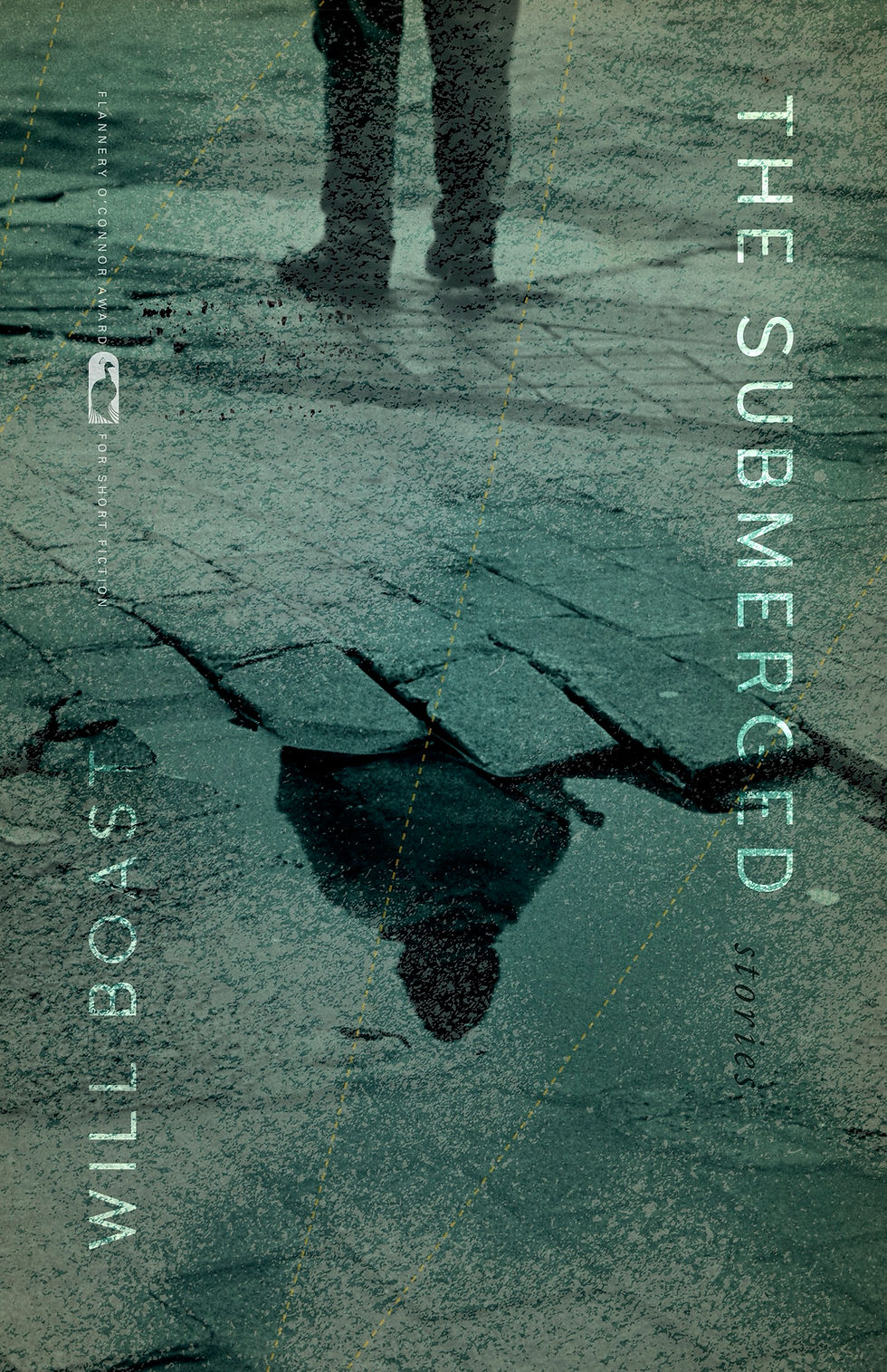
To read Will Boast’s The Submerged—winner of the Flannery O’Connor Award for Short Fiction—is to enter a world where the most profound truths are found in the “regelation right at the phase boundary.” This is a collection that explores the lightless depths of the human experience, a collection that focuses on those individuals who are, quite literally or metaphorically, running silent and deep.
The overarching theme of the collection is the precarious, often agonizing nature of belonging. Boast’s characters are frequently outsiders—refugees, migrants, or “the last of the Dodos”—treading water in places that never quite feel like home. In “The Human Conditional,” the very structure of the English language becomes a battlefield of hope and regret. Here, a teacher in a Roman refugee center uses the “if” of the conditional tense to bridge the chasm between a harrowing past and an unlikely future. We see Sarwar, an Afghan farm boy, struggling to conjugate his dreams, and Ahmed, a man whose body is a map of trauma, “hitching his leg down the cobblestone sidewalk” like a ghost in a tourist’s paradise.
This sense of displacement is echoed in “The Barber of Erice,” where the arrival of Baba, a Liberian refugee with “mangled hands,” upends the stagnant life of Giuliu, a local barber. Boast masterfully explores how “change doesn’t come this far up the mountain” until it arrives in the form of a “miraculous haircut” textured with lightning bolts. These are stories about the weight of what we carry beneath the surface, whether it is the “internal bleeding” of a life stalled out in an Oklahoma motel or the “suede voice” inherited from a father who spent his life refinishing floors.
Boast’s craft is characterized by a “patient process” of revelation. He possesses a jeweler’s eye for the specific, tactile detail that anchors a story in its setting. Whether he is describing “Hitachi blades” singing against an oil stone in a Sicilian shop, a “bronze anchor” bearding a pristine Wisconsin lawn, or a “thirteen-year-old son” with lightning bolts carved into his stubble, the prose is as sharp as a straight razor. He handles social friction and class with an unflinching hand, particularly in “Decoys,” where the “offhand, obliterating beauty” of city girls in creaking cowboy boots is contrasted with the “salmon stink” of the local night crew. There is a gritty realism in the “dull, dusty hours” of stocking shelves that feels both heavy and essential.
What makes this an outstanding collection is Boast’s ability to find “ordinary beauty” in the “horse latitudes” of grief and transit. He doesn't shy away from the jagged edges—the “sick flesh flower” of a gunshot wound in “In the Leaves” or the “trashy” aspirations of a girl wanting to escape a hog farm through beauty school. In “At the Center of the Sailing World,” we watch Lomax, a man who has “sailed around the world” but “never steered,” attempt to navigate the void left by his wife’s stroke. Boast captures the unique “quiet” of a body shut up inside itself, a silence that feels as vast as the “flat indigo” of a submarine’s wake.
The title story, “The Submerged,” serves as a haunting centerpiece, tracing a decades-long connection between a green architect and a Naval officer on a “Los Angeles–class submarine.” Here, Boast analyzes the “Silent Service” of those who live their lives “running silent,” submerged under the weight of “Pax Americana” and personal failure. The metaphor of the submarine—trapped, groaning, “going down together”—becomes a potent symbol for the entire collection.
Ultimately, The Submerged is a tessellation of lives caught in the “breath of the Sahara” or under the “fluorescent glare” of a late-night diner. It is a collection for those who understand that “nothing whips you harder than time,” and yet, like a well-carved cedar decoy, there is something “monolithic, eternal” in the way these characters continue to float. Boast reminds us that “there is a recurring sense of possibility and the chance, always, for change,” even if that change arrives with the violence of a breaking visor on the lunar surface. Elegant, slightly lugubrious, and entirely necessary, Boast’s stories remind us that we are all, in some way, waiting for the world to right itself.

Tony Huang, PhD, is the founder and editor-in-chief of The Hong Kong Review. He is also the founder of Metacircle Fellowship, Metacircle (Hong Kong) Culture and Education Co., Ltd. and Metaeducation. He works as a guest-editor for SmokeLong Quarterly. His poems and translations have appeared in Mad Swirl, The Hong Kong Review, The Best Small Fictions Anthology Selections 2020, Tianjin Daily, Binhai Times, SmokeLong Quarterly, Nankai Journal, Large Ocean Poetry Quarterly, Yangcheng Evening News and other places.
Copy Editor: Nancy He


Comments